Before you begin. This procedure is general reference information, not professional advice. Equipment varies by manufacturer, model, and year. Always follow the documentation supplied with your equipment — where it differs from this page, follow the manufacturer. Verify that you have the tools, the working conditions, and the ability to do this task safely. If anything is unclear, if the equipment is damaged, or if the task exceeds your experience, stop and use a qualified professional. You are responsible for your own safety and for the outcome. This site accepts no liability for any loss, damage, or injury arising from the use of this information.
Specifications marked unverified could not be traced to a manufacturer source. Do not rely on them — obtain the value from your equipment documentation.
Summary
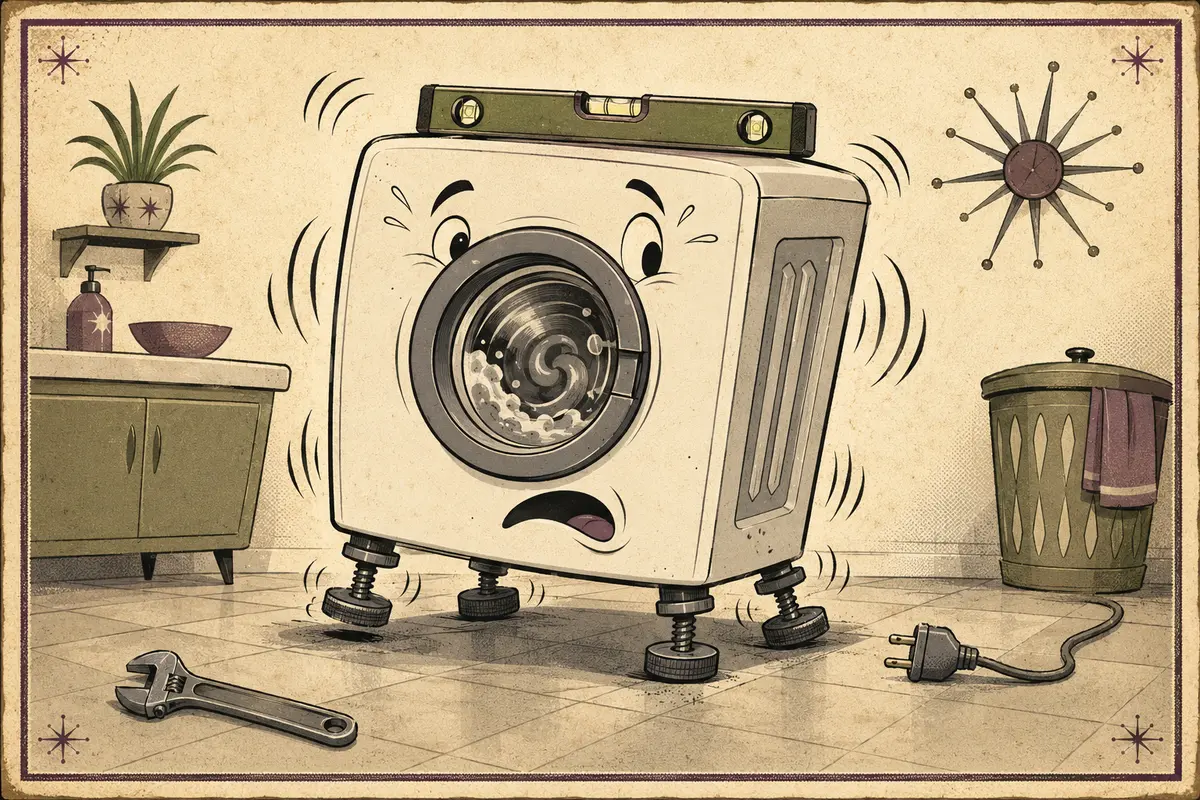
A washing machine that walks across the laundry floor, bangs against the wall or shakes the house on the spin is almost never broken. It is standing on four adjustable feet, at least one of them is not carrying its share of the weight, and the drum is doing the rest. On a brand-new machine there is a second suspect that catches thousands of people every year: the shipping bolts that hold the drum still in transit are still fitted, and no amount of levelling will help until they come out.
The work is a wrench, a bubble level and about an hour, and the only genuinely awkward part is that a washing machine is heavy and you need a second pair of hands. This page will not tell you which way to turn the feet on your machine. Only LG publishes a direction, it publishes it for its own front-loaders, and the answer depends on whether your foot is a bolt threaded up into the cabinet or a nut running down a stud. Turn it, watch the corner, and let the machine tell you.
Necessary equipment
| Item | Note |
|---|---|
| Wrench | LG gives the wrench that comes with the machine. |
| Bubble level | LG tells you to put a level across the top of the machine. |
| Block of wood | GE Appliances gives a piece of wood below the front to hold the machine. |
| Flashlight optional | The space below the machine is dark. |
| Pliers optional | Only if the lock nut is tight and the wrench does not hold it. |
Find the cause of the movement
Estimated 10 min to 18 min
- Set the washing machine to OFF.<1mReport a problem with step 1, Find the cause of the movement
DISCONNECT THE WASHING MACHINE FROM THE ELECTRICAL SUPPLY BEFORE YOU MOVE IT.
Contact with the supply can give you an electric shock.
- Disconnect the washing machine from the electrical supply.<1mReport a problem with step 2, Find the cause of the movement
- Remove the plug from the wall outlet.
- Look at the rear of the machine for shipping bolts.2mReport a problem with step 3, Find the cause of the movement
- LG says that these bolts hold the tub still while the machine is in transit.
- A machine that is more than one year old usually has no bolts in it.
REMOVE THE SHIPPING BOLTS BEFORE YOU OPERATE A NEW MACHINE.
LG says that these bolts can cause severe vibration and permanent damage.
- If the shipping bolts are in the machine, remove all of them.7mReport a problem with step 4, Find the cause of the movement
- LG tells you to use a suitable wrench for the bolts.
- LG tells you to put the caps into the holes after you remove the bolts.
- Keep the bolts. You must install them again if you move house.
- Remove all the clothes from the drum.1mReport a problem with step 5, Find the cause of the movement
- Whirlpool says that one bulky item can make a machine vibrate.
- Whirlpool tells you to add some other items to balance a rug or a jacket.
Prepare the washing machine
Estimated 7 min to 9 min
DO NOT PULL THE WASHING MACHINE BY ITS HOSES.
Water comes onto the floor from a loose hose.
- Move the washing machine away from the wall.3mReport a problem with step 1, Prepare the washing machine
- Move the machine only as far as the hoses let it go.
- Get access to all four feet.
- Examine the floor below the machine.2mReport a problem with step 2, Prepare the washing machine
- Whirlpool tells you to look for a floor that flexes or sags.
- Whirlpool says that you must not install the machine on a raised wooden platform.
- GE Appliances says that the machine needs a good solid floor.
- Clean the floor below each foot.2mReport a problem with step 3, Prepare the washing machine
- Dirt below a foot prevents contact with the floor.
- Water and lint collect below a machine.
Measure the machine with a level
Estimated 2 min
No tier-1 source was found for this value. Take it from the documentation supplied with your equipment.
- Put the bubble level across the top of the machine.<1mReport a problem with step 1, Measure the machine with a level
- LG tells you to put a level across the top of the washer.
- Read the bubble from side to side and then from front to rear.2mReport a problem with step 2, Measure the machine with a level
- LG tells you to adjust the feet until the bubble stays in the middle.
- Write down which corner is low.
Adjust the four feet
Estimated 17 min to 26 min
No tier-1 source was found for this value. Take it from the documentation supplied with your equipment.
ASK A SECOND PERSON TO HELP YOU BEFORE YOU LIFT THE WASHING MACHINE.
A washing machine is heavy. It can fall and crush your foot.
- Ask the second person to lift the front of the machine.1mReport a problem with step 1, Adjust the four feet
- Lift the front only as high as the block of wood.
- GE Appliances tells you to tip the machine back to lift the two front legs.
DO NOT PUT YOUR HAND BELOW THE WASHING MACHINE WHILE A PERSON HOLDS IT.
A machine that falls can crush your hand.
- Put the block of wood below the front of the machine.1mReport a problem with step 2, Adjust the four feet
- GE Appliances gives a piece of wood 2 by 4 inches for this.
- Keep your fingers on the sides of the block.
- Loosen the lock nut on the low foot with the wrench.2mReport a problem with step 3, Adjust the four feet
- The lock nut is the nut between the foot and the cabinet.
- LG tells you to loosen the nut until you can turn the foot.
- Turn the foot a small amount in one direction.2mReport a problem with step 4, Adjust the four feet
- The direction that raises a foot is not the same on all machines.
- LG says that a clockwise turn raises its front-load machines.
- If the corner goes down, turn the foot in the other direction.
- Make the foot only as long as necessary.1mReport a problem with step 5, Adjust the four feet
- GE Appliances says that a long leg makes the machine less stable on the spin.
- Remove the block of wood.<1mReport a problem with step 6, Adjust the four feet
- Ask the second person to lower the machine slowly.
- Rock the machine from one corner to the opposite corner.1mReport a problem with step 7, Adjust the four feet
- Whirlpool tells you to adjust the feet if the washer teeters.
- LG tells you to rock the washer gently.
- Rock the machine from side to side.1mReport a problem with step 8, Adjust the four feet
- Whirlpool tells you to grip the washer at the top for this.
- Do steps 11 to 18 again for each foot that is not correct.8mReport a problem with step 9, Adjust the four feet
- Adjust one foot only between each test.
- Two feet adjusted together hide the fault from you.
Lock the feet
Estimated 6 min to 10 min
No tier-1 source was found for this value. Take it from the documentation supplied with your equipment.
- Tighten the lock nut on each foot against the cabinet.4mReport a problem with step 1, Lock the feet
- Whirlpool says that the jam nuts must be tight against the bottom of the cabinet.
- Hold the foot with one hand while you tighten the nut.
- Make sure that all four feet touch the floor.1mReport a problem with step 2, Lock the feet
- Whirlpool and LG both give firm contact with the floor for all four feet.
- Read the bubble level again from side to side and from front to rear.2mReport a problem with step 3, Lock the feet
- A tight lock nut can move a foot a small amount.
Make sure that the machine is stable
Estimated 16 min
- Move the machine back to its position.3mReport a problem with step 1, Make sure that the machine is stable
- Do not let the machine drop onto the floor.
- Make sure that the hoses stay clear of the rear of the machine.
MAKE SURE THAT ALL FOUR FEET TOUCH THE FLOOR BEFORE YOU START A PROGRAM.
A machine that moves on the spin can cause damage to itself and to the floor.
- Connect the washing machine to the electrical supply.<1mReport a problem with step 2, Make sure that the machine is stable
- Put a small load of clothes into the drum.2mReport a problem with step 3, Make sure that the machine is stable
- LG gives about six pounds of laundry for this test.
- Select a rinse and spin program.<1mReport a problem with step 4, Make sure that the machine is stable
- LG gives the RINSE and SPIN program for this test.
- Start the program.<1mReport a problem with step 5, Make sure that the machine is stable
- Look at the machine during the spin.10mReport a problem with step 6, Make sure that the machine is stable
- GE Appliances says that movement up to a quarter of an inch can be normal.
- Stay clear of the machine. Do not hold it.
- Do steps 11 to 22 again if the machine still moves a large amount.
- Record the date.<1mReport a problem with step 7, Make sure that the machine is stable
Terminology
This page uses one term for each item and holds it throughout, as ASD-STE100 requires. Equipment sellers and other guides use the names below for the same parts.
- leveling foot
- Also called: leveling leg, levelling foot, adjustable foot, washer leg, washing machine leg, the screw feet, the little feet at the bottom
- lock nut
- Also called: jam nut, locknut, locking nut, lock ring, the nut on the leg
- shipping bolt
- Also called: transit bolt, transport bolt, shipping brace, transit bracket, drum bolt, the bolts on the back of a new washer
- bubble level
- Also called: spirit level, level, carpenter's level, bubble, levelling tool
- walking
- Also called: washing machine moving across the floor, washer jumping, washer dancing, banging on spin, shaking, vibrating, washer moves when it spins
When to use a professional
Stop if the floor flexes or sags below the machine. Whirlpool says that the machine must not go on a raised wooden platform. A floor that moves is work for a builder.
Stop if the machine moves a large amount after all four feet are correct and tight. The cause is then inside the machine. Worn bearings, a broken spring and a loose counterweight all give this result. None of them is a fault of the feet. Speak to an appliance technician.
Stop if a foot turns but the corner does not move. Stop if a foot comes out of the cabinet. The thread in the base has damage. Do not put a shim below a bad foot.
Do not put the machine on a pedestal that came with a different machine. The feet must not stay on the machine for a pedestal installation. The machine then bolts to the pedestal. The installation instructions for your model give that procedure.
Common questions
Why does my washing machine walk across the floor when it spins?
Because at least one of its four feet is not carrying weight, so the drum's out-of-balance force gets to lift a corner instead of being fed into the floor. Whirlpool puts it plainly: front and rear feet must be in firm contact with the floor and the washer must be level to operate correctly. The other three usual suspects are shipping bolts still fitted on a new machine, a soft or springy floor, and a single heavy item like a bath mat washed on its own.
What are the four bolts on the back of my new washer?
Shipping bolts, and they must come out before the first wash. LG explains that they are fastened at the rear to fix the tub in place during transport, and warns that failure to remove them can cause severe vibration and noise leading to permanent damage. Take them out with a wrench and fit the supplied caps into the holes. Keep the bolts somewhere safe: you need them again if you ever move house.
Which way do I turn the feet to raise the washer?
This page will not tell you, and that is deliberate. LG is the only one of the four manufacturer sources here that publishes a direction, and it publishes it for its own front-load machines: clockwise to raise, counterclockwise to lower. Whirlpool and GE publish the procedure without a direction at all. Whether the foot is a bolt threaded up into the cabinet or a nut running down a fixed stud changes the answer, and so does whether you are looking at it from above or from the floor. Turn it a little, watch the corner, and reverse if it went the wrong way.
How level does a washing machine actually have to be?
None of the four manufacturer sources on this page publishes a tolerance in degrees, millimetres or bubble widths, so this page does not print one either. What they publish is a test instead of a number: Whirlpool says rock it diagonally corner to corner and adjust if it teeters, LG says get the bubble to stay in the middle and then run a rinse and spin with about six pounds of laundry. Pass both and the machine is level enough for the machine that has to live with it.
Is it normal for the washer to move a bit on the spin?
A little, yes. GE Appliances is the only source here that puts a figure on it and says movement up to a quarter of an inch can be normal on occasion. Anything you would describe as walking, banging or shaking the room is not normal, and it is what this procedure is for.
Can I just shove a piece of wood or a shim under the low corner?
No, and Whirlpool is specific about the bigger version of this idea: do not install the appliance on a raised wooden platform. A shim under one foot is worse than a badly adjusted foot, because it can shift, and the machine will find it during the spin. The feet exist precisely so that no shim is ever needed. If a foot will not adjust, the thread is damaged and that is a repair, not a levelling problem.
My washer is upstairs on floorboards and the whole room shakes. What now?
Level it first, because a machine that is out of level will shake any floor. If it is level, all four feet are tight and it still shakes the room, the problem is the floor rather than the washer. Whirlpool tells you to check the floor for flexing or sagging. Stiffening a suspended timber floor is a builder's job, and no amount of adjustment at the feet substitutes for it.
Related procedures
- How to refit the transit bolts in a washing machine before you move it
- How to clean the drain filter on a front loading washing machine
- How to check and replace the fill hoses on a washing machine
- How to clean the rubber door seal on a front loading washing machine
- How to run the tub-clean cycle on a washing machine and what to put in it
- How to clean a clogged dryer vent and lint duct
Sources
Every specification on this page is traced to one of these sources. Tier 1 is a manufacturer document, a published standard, or a government safety authority. See Standards for the full tiering rule.
- Tier 1Leveling a Front Load Washer
- Tier 1Vibration, Walking or Off Balance - Front Load Washer
- Tier 1LG washer - How to Level an LG Front Load Washing Machine
- Tier 1LG Washer – Troubleshooting Vibration Issues
- Tier 1Front Load Washer - Walking, Vibrating, Shaking, or Moving
- Tier 1Washer - Leveling the Legs
Revision history
Current version 1 · updated 2026-07-29 · next review due 2027-07-29
- v1 · 2026-07-29First draft. Sourced to Whirlpool, LG and GE Appliances levelling and vibration documentation. Turn direction, levelness tolerance and lock nut torque all publish as consult-the-manufacturer: only LG publishes a direction and it publishes it for LG front-loaders only, and no source publishes a tolerance or a torque.
Corrections to this page are listed in the public corrections log. Reports that are credible and not yet verified are listed in the public errata register, and an open one renders above the step it concerns.
Comments and corrections
Found an error? A correction with a manufacturer source is applied and logged publicly. You can also write to corrections@fixchecklist.com.
Every step above carries its own report control, which tags the report with that step so a correction reaches the right place. For anything about the procedure as a whole — the order of the sections, a step that is missing, something that did not match your equipment — use this: report something about this whole procedure.