Before you begin. This procedure is general reference information, not professional advice. Equipment varies by manufacturer, model, and year. Always follow the documentation supplied with your equipment — where it differs from this page, follow the manufacturer. Verify that you have the tools, the working conditions, and the ability to do this task safely. If anything is unclear, if the equipment is damaged, or if the task exceeds your experience, stop and use a qualified professional. You are responsible for your own safety and for the outcome. This site accepts no liability for any loss, damage, or injury arising from the use of this information.
Specifications marked unverified could not be traced to a manufacturer source. Do not rely on them — obtain the value from your equipment documentation.
Summary
Most dishwashers made in the last fifteen years filter the wash water instead of grinding the food up, and that filter sits in the floor of the tub where nobody looks. When it loads up you get gritty glasses, a film on plastics, and a smell that no amount of rinse aid fixes. The job needs no tools and takes about a quarter of an hour.
This page gives the sequence that is common to every removable-filter dishwasher, and it deliberately does not print the one thing you might expect it to. Filters release in different directions and come apart into a different number of pieces depending on who made the machine, so the release direction here is an instruction to check your own documentation rather than a guess. The cleaning interval is the same story: two manufacturers we checked give two different answers, and both are printed below with their names against them.
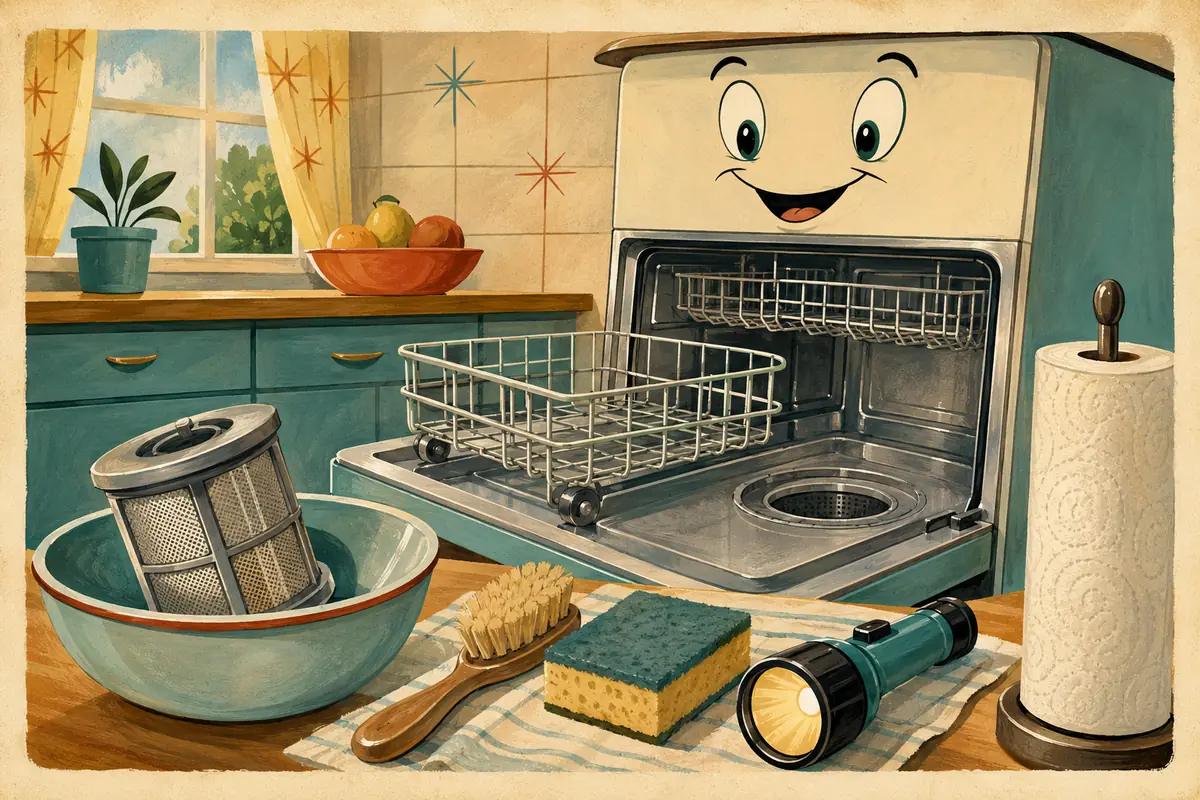
Necessary equipment
| Item | Note |
|---|---|
| Soft brush | An old toothbrush is sufficient. |
| Sponge optional | For the flat parts of the filter. |
| Flashlight optional | The floor of the tub is a dark space. |
| Paper towel | For the soil that you remove from the filter well. |
Prepare the dishwasher
Estimated 4 min
No tier-1 source was found for this value. Take it from the documentation supplied with your equipment.
- Set the dishwasher to OFF.<1mReport a problem with step 1, Prepare the dishwasher
WAIT UNTIL THE DISHWASHER IS COOL BEFORE YOU OPEN THE DOOR.
Water and steam from a recent program can burn your skin.
- Open the door of the dishwasher.<1mReport a problem with step 2, Prepare the dishwasher
- Remove the lower rack from the dishwasher.<1mReport a problem with step 3, Prepare the dishwasher
- Find the filter in the floor of the tub.1mReport a problem with step 4, Prepare the dishwasher
- The filter is usually below the lower spray arm.
- Most dishwashers have a filter with a circular part and a flat part.
- Some dishwashers have a filter that you cannot remove.
- Read the manufacturer documentation for the release direction.2mReport a problem with step 5, Prepare the dishwasher
- The number of filter parts is different on different models.
- The release direction is different on different models.
- Whirlpool gives a quarter turn counterclockwise for the upper part.
- GE holds the lower filter with two posts that you turn.
Remove the filter
Estimated 2 min
EXAMINE THE FILTER WELL BEFORE YOU PUT YOUR HAND INTO IT.
Broken glass and sharp items collect in the filter. These can cut your hand.
- Turn the upper part of the filter to release it.<1mReport a problem with step 1, Remove the filter
- Do not use force. A filter that does not turn is usually a filter that turns the other way.
- Lift the upper part of the filter clear of the tub.<1mReport a problem with step 2, Remove the filter
- Lift the lower filter with care.<1mReport a problem with step 3, Remove the filter
- Move the lower filter forward to remove it.<1mReport a problem with step 4, Remove the filter
- Examine the filter well for broken glass.<1mReport a problem with step 5, Remove the filter
- Remove any hard object from the filter well.<1mReport a problem with step 6, Remove the filter
- Use a paper towel for the soft soil.
- Fruit stones, glass and bone collect in the filter well.
Clean the filter
Estimated 4 min to 8 min
DO NOT USE A WIRE BRUSH OR AN ABRASIVE PAD ON THE FILTER.
These tools can cause damage to the mesh of the filter.
- Rinse the filter parts under warm water.1mReport a problem with step 1, Clean the filter
- Clean the mesh with a soft brush.2mReport a problem with step 2, Clean the filter
- Move the brush from the clean side to the dirty side.
- This pushes the soil out of the mesh.
- If the soil stays, put the filter parts in warm water for some minutes.1mReport a problem with step 3, Clean the filter
- Rinse the filter parts again.<1mReport a problem with step 4, Clean the filter
- Examine the mesh for damage.<1mReport a problem with step 5, Clean the filter
- A hole in the mesh can let food soil into the pump.
- Speak to the manufacturer for a replacement part.
Install the filter
Estimated 2 min
- Put the lower filter into its position in the floor of the tub.<1mReport a problem with step 1, Install the filter
- Put the upper part of the filter into the circular opening.<1mReport a problem with step 2, Install the filter
MAKE SURE THAT THE FILTER LOCKS IN ITS POSITION BEFORE YOU START A PROGRAM.
A loose filter can let food soil into the pump.
- Turn the upper part of the filter until it locks.<1mReport a problem with step 3, Install the filter
- The lock direction is the opposite of the release direction.
- Make sure that the lower filter is flat in its position.<1mReport a problem with step 4, Install the filter
- Install the lower rack in the dishwasher.<1mReport a problem with step 5, Install the filter
After the job
Estimated under a minute
No tier-1 source was found for this value. Take it from the documentation supplied with your equipment.
- Close the door of the dishwasher.<1mReport a problem with step 1, After the job
- Record the date.<1mReport a problem with step 2, After the job
- A record of the date makes the next interval easy to find.
Terminology
This page uses one term for each item and holds it throughout, as ASD-STE100 requires. Equipment sellers and other guides use the names below for the same parts.
- dishwasher filter
- Also called: dishwasher screen, dishwasher trap, food trap, dishwasher drain filter, dishwasher strainer, dishwasher catcher
- upper filter assembly
- Also called: cup filter, cylinder filter, round filter, ultra fine filter, the twisty bit
- lower filter
- Also called: flat filter, fine filter, mesh screen, bottom screen
- filter well
- Also called: sump, dishwasher sump, the hole under the filter, drain basin
- spray arm
- Also called: sprayer, wash arm, the spinning thing, propeller
When to use a professional
Stop if you cannot find the filter. Some dishwashers have a filter that you cannot remove. The documentation for your model tells you which type you have.
Stop if the mesh has a hole or a crack. A damaged filter can let food soil into the pump. Speak to the manufacturer for a replacement part.
Stop if water stays in the floor of the tub after a program. A blockage in the drain is not part of this procedure. Speak to an appliance technician.
Common questions
How often should I clean my dishwasher filter?
The two manufacturer sources this page rests on do not agree, so we print both rather than splitting the difference. Whirlpool says once a month as a general rule, and every two weeks if you have a large family or run the machine daily. GE Appliances says every other month, or more often depending on use. Your own manual is the tie-breaker. If the machine smells or glasses come out gritty, clean it now regardless of the interval.
Which way does a dishwasher filter twist to come out?
It depends on the machine, which is why this page tells you to look it up rather than printing one answer. Whirlpool describes a quarter turn counterclockwise on the upper filter assembly, then lifting the lower filter slightly and pulling it forward. GE describes twisting the ultra fine filter counterclockwise, and then twisting two separate retaining posts counterclockwise to free the fine filter underneath. Those are two different mechanisms with two different part counts. Never force a filter that will not turn: it is almost always turning the wrong way rather than stuck.
Does my dishwasher even have a filter I can take out?
Not all of them do. Older machines and some current models use a hard food disposer that grinds debris instead of trapping it, and those have no user-serviceable filter. If there is nothing in the floor of the tub that twists or lifts, check your manual before you pry at anything.
Why does my dishwasher smell bad?
A loaded filter is the most common reason. Food debris sits in the filter and the sump between cycles and goes off, and no rinse aid or cycle setting will cover it. Cleaning the filter usually fixes the smell within a load or two.
Can I just run the filter through the dishwasher to clean it?
No. The filter is what catches the debris, so it cannot clean itself, and a filter that is out of position lets food into the pump. Rinse it under the tap by hand and use a soft brush on the mesh.
Do I still need to rinse plates if I clean the filter regularly?
Scrape, do not rinse. Modern dishwashers are designed to handle food soil, and the filter is the part that copes with it. Scraping bones, stones and large scraps into the bin is what keeps the filter well clear of the hard objects that are awkward to fish out later.
Related procedures
- Decide why water is standing in the bottom of a dishwasher
- How to clean the drain filter on a front loading washing machine
- How to check if your dishwasher drain hose has a high loop
- Decide why a dishwasher leaves a white film or grit on glassware
- How to clean the lint filter in a tumble dryer
- How to clean a greasy range hood filter
- How to change the water filter in a fridge with a water dispenser or icemaker
Sources
Every specification on this page is traced to one of these sources. Tier 1 is a manufacturer document, a published standard, or a government safety authority. See Standards for the full tiering rule.
- Tier 1How to Clean the Dishwasher Filters
- Tier 1Dishwasher — How to Clean Fine and Ultra Fine Filters
Revision history
Current version 1 · updated 2026-07-29 · next review due 2027-07-29
- v1 · 2026-07-29First draft. Sourced to Whirlpool and GE Appliances service documentation. Release direction and cleaning interval both publish as consult-the-manufacturer: the mechanism differs by maker and the two intervals disagree.
Corrections to this page are listed in the public corrections log. Reports that are credible and not yet verified are listed in the public errata register, and an open one renders above the step it concerns.
Comments and corrections
Found an error? A correction with a manufacturer source is applied and logged publicly. You can also write to corrections@fixchecklist.com.
Every step above carries its own report control, which tags the report with that step so a correction reaches the right place. For anything about the procedure as a whole — the order of the sections, a step that is missing, something that did not match your equipment — use this: report something about this whole procedure.